A pipe bursts at 2:00 a.m., water moves through two units before anyone sees it, and by morning you are balancing tenant communication, mitigation decisions, and an insurance carrier that wants documentation right away. That is exactly where an insurance claim cleanup guide becomes useful - not as theory, but as an operational playbook for protecting the building, the claim, and your timeline.
For property managers and owners, cleanup after water, fire, or sudden property damage is never just about drying out materials or removing debris. It affects vacancy days, tenant retention, repair scope, reserve planning, and insurance recovery. The quality of your response in the first 24 to 72 hours often shapes everything that follows.
Why an insurance claim cleanup guide matters
Insurance carriers generally expect two things at once: immediate action to prevent further damage and clear proof of what happened. That creates pressure. If you wait too long to mitigate, damages can spread and parts of the loss may be questioned. If cleanup starts without proper records, it becomes harder to support the claim later.
That tension is why a practical process matters. The right approach helps you stabilize the property without creating gaps in documentation. It also keeps your internal team from scrambling between tenants, ownership, vendors, and adjusters.
In multi-unit and commercial settings, the stakes are even higher. One small leak can affect adjoining walls, shared corridors, electrical systems, or lower-level units. A smoke event in one area can trigger odor and HVAC concerns elsewhere. Cleanup decisions are rarely isolated to a single room.
First response: protect people, stop the loss, document everything
The first job is safety. If there is active water intrusion near electrical systems, structural concern, sewage backup, or fire-related hazards, the area should be secured before anything else. In occupied properties, that also means giving tenants clear direction about access, temporary restrictions, and next steps.
Once the area is safe, the next priority is to stop the source of damage. Shut off the water line, secure roof tarping if storm exposure is involved, or isolate affected spaces to limit smoke, soot, or contamination spread. Insurance carriers usually expect reasonable mitigation, and delaying that step can increase both restoration complexity and claim friction.
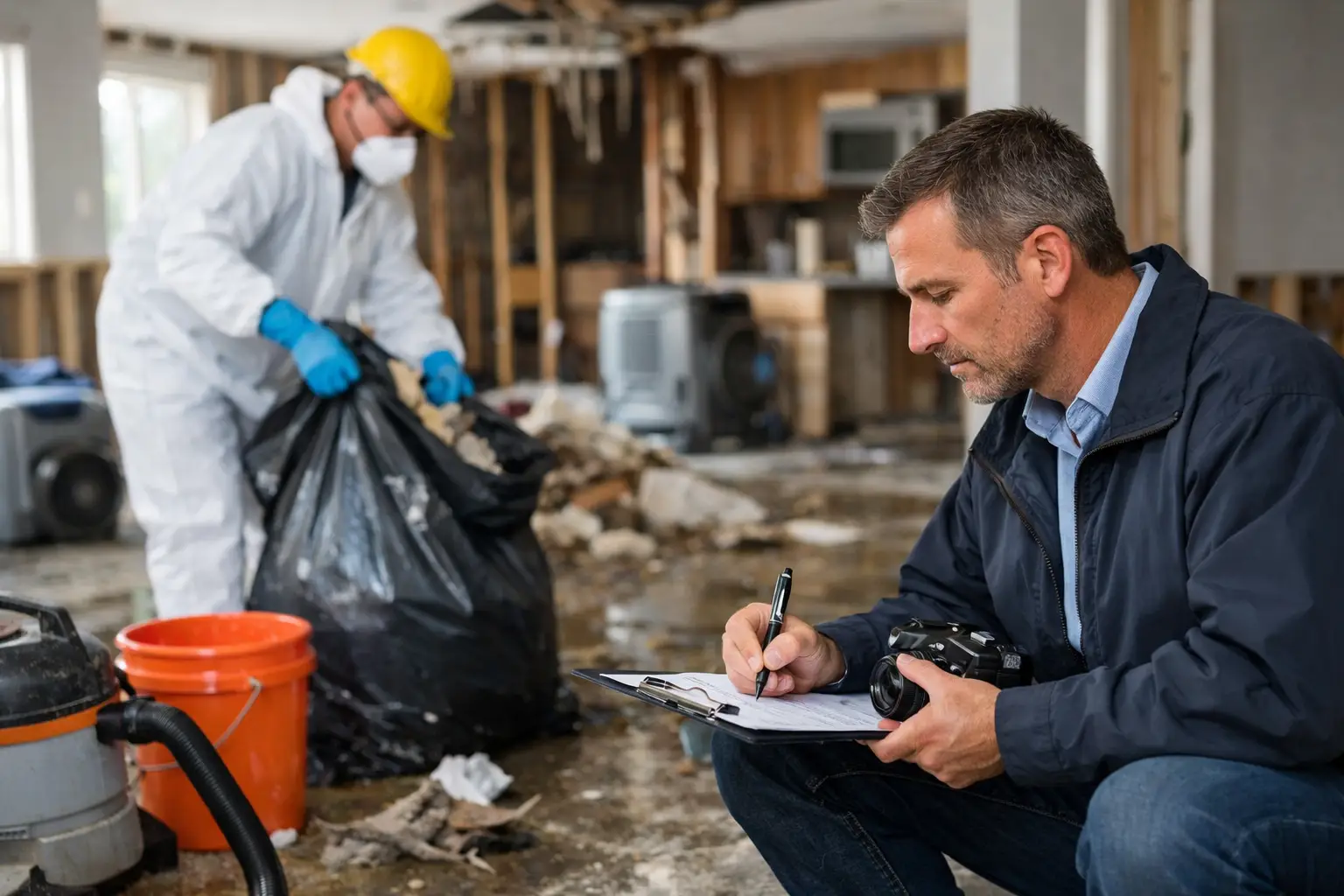
At the same time, begin documenting the loss in a disciplined way. Take wide shots and close-ups. Capture affected units, common areas, visible material damage, and any damaged contents or building components. Keep notes on the time the damage was discovered, who reported it, what immediate actions were taken, and which areas appear impacted.
Photos alone are not enough. A simple incident log matters because claims often stretch over weeks or months. Details that feel obvious on day one are easy to lose by week three.
A property manager's insurance claim cleanup guide to documentation
Good documentation is what keeps cleanup and claim handling aligned. In practice, that means creating a record that is organized enough for the carrier and useful enough for ownership.
Start with the basic claim file: date of loss, suspected cause, affected units or suites, emergency contact activity, and any tenant statements that help establish the timeline. Then build from there with photos, mitigation reports, moisture readings if water is involved, emergency work authorizations, and all invoices tied to cleanup and stabilization.
This is where vendor quality matters. A trusted general contractor or restoration partner should provide clear scope notes, before-and-after documentation, and itemized records that support the file. If a vendor is vague, slow to report, or inconsistent in what they document, the burden shifts back to your office.
There is also a practical balance to strike. You do not need to over-document every minor issue, but large losses and multi-unit impacts demand more rigor. If three units share a wall assembly or if flooring runs continuously through connected spaces, partial photos rarely tell the full story. Document the full spread of impact, not just the most visible damage.
Choosing the right cleanup partner after a loss
Not every cleaning crew is equipped for insurance-driven work. Routine janitorial service and claim-related cleanup are different jobs. Insurance losses require fast mobilization, technical mitigation, reliable reporting, and coordination with adjusters, occupants, and reconstruction teams.
For property professionals, compliance is not optional. Your cleanup partner should be fully licensed, bonded, and insured, with the ability to work in occupied and multi-unit environments. They should also understand how emergency mitigation connects to downstream repairs, because a disconnected handoff between cleanup and reconstruction often creates delays, duplicated work, and avoidable disputes.
Speed matters, but so does judgment. In some losses, aggressive demolition is appropriate to prevent hidden moisture or contamination from spreading. In others, controlled drying and selective removal may preserve more material and reduce claim scope. The right answer depends on the cause of loss, building type, material conditions, and how quickly the response begins.
That is one reason many Southern California property teams prefer a single-source partner. When the same qualified team can handle emergency cleanup, reporting, repair planning, and reconstruction, there is less room for confusion and fewer handoff failures.
What insurance carriers usually want to see
Carriers do not all handle claims the same way, but most are looking for a consistent set of facts. They want to know what caused the damage, when it was discovered, what was affected, what was done to prevent further loss, and whether the work performed was reasonable and related to the incident.
That means your file should show a clean chain of events. If a unit had standing water on Monday, mitigation began Monday, drying reports were generated Tuesday through Thursday, and demolition occurred only where materials failed or moisture remained elevated, that tells a clear story. If records are incomplete and invoices appear before photos or site notes, questions follow.
It also helps to separate emergency mitigation from rebuild work in your records. Those phases may be handled under the same overall claim, but they serve different purposes. Mitigation stabilizes the site and limits further damage. Reconstruction restores the property. Treating them as separate phases can make the claim easier to understand and manage.
Common cleanup mistakes that complicate claims
The most common mistake is waiting. Property teams sometimes pause because they want adjuster approval before acting, but active damage does not stop while paperwork catches up. Reasonable emergency mitigation is usually expected.
The second mistake is incomplete communication. Tenants, owners, vendors, and carriers all need accurate updates, but they do not all need the same level of detail. A strong manager filters the right information to the right party at the right time.
The third mistake is hiring based only on immediate availability. Fast response is critical, but if the vendor cannot document properly, misses compliance requirements, or lacks reconstruction capability, the early convenience may cost more time later.
Another common issue is underestimating hidden damage. Water behind cabinets, moisture under flooring, smoke migration through ventilation, and contamination in wall cavities are not always visible in the first walkthrough. Cleanup scope should be informed by inspection, not just appearance.
How to keep repairs moving after cleanup begins
The best claims do not stall between mitigation and rebuild. As soon as the site is stabilized, the next phase should be taking shape: repair scope, scheduling, tenant access planning, and material decisions that align with both insurance recovery and operational needs.
This is where experienced coordination makes a measurable difference. In occupied properties, temporary containment, phased work, and communication windows can keep disruption lower. In vacant turns, the focus is usually speed - getting from damage assessment to rent-ready condition without unnecessary idle time.
It also helps to think beyond the claim itself. If a water loss exposes older finishes that were already near replacement, ownership may choose to combine claim-covered repairs with planned upgrades. That decision depends on budget, timing, and lease strategy, but it should be made early so scopes do not conflict.
For many property professionals, the strongest outcome is not just an approved claim. It is a controlled process that protects the asset, limits downtime, and keeps accountability with one responsive team. That is the standard V&S Management Services Inc. has built its reputation around for Southern California properties that cannot afford drawn-out recovery.
The real goal of an insurance claim cleanup guide
A good insurance claim cleanup guide is not about turning property managers into restoration specialists. It is about helping you make sound decisions under pressure. Stop the damage, document the facts, bring in compliant professionals, and keep the file organized from day one.
Claims rarely go perfectly. Some losses are straightforward, while others involve tenant disputes, hidden damage, or scope questions that take time to resolve. But a disciplined response gives you better leverage, better records, and a better chance of moving from emergency to restoration without losing control of the process.
When the next loss happens, the goal is not to improvise better. It is to respond with a plan that protects both the property and the people relying on it.